
CRISIS = UTOPIA. An encapsulated research centre on climate change
(001) CRISIS = UTOPIA
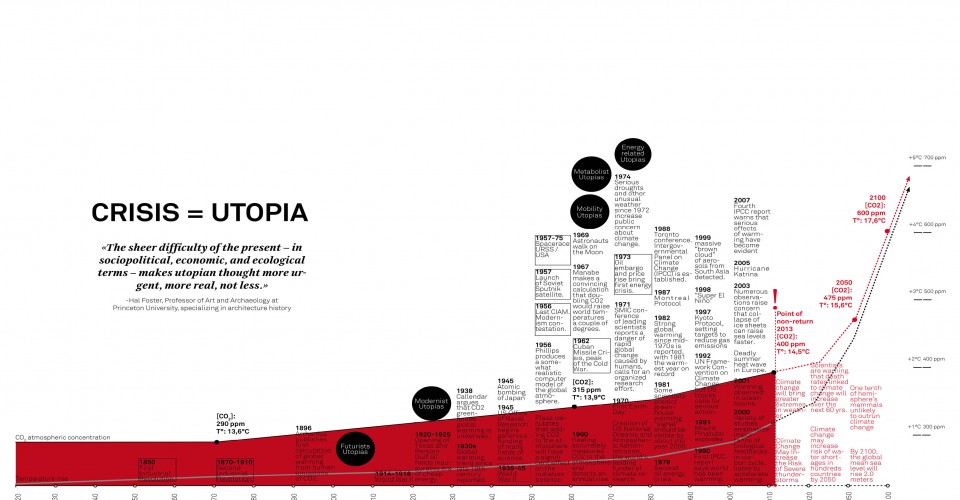
If we are to consider that nearly one in ten mammals would not survive climate change, that human deaths related to global warming will increase in the next sixty years, that sea levels are expected to rise by up to 2.0 meters by 2100 and that the point of no-return in terms of atmospheric concentration was reached in May of 2013, we can only conclude that we exist in a state of crisis due the global warming.
Historically, there has been a correlation between crisis and the emergence of utopias. The contemporary context is a new playground for utopia, this place, both real and imaginary, enables innovation by freeing itself from the constraints of immediate feasibility.
EXPERIMENTAL CAPSULES
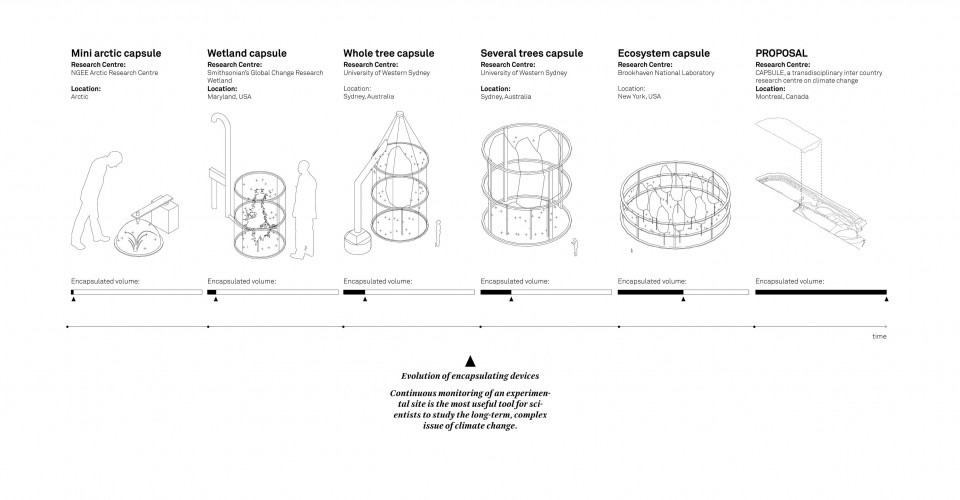
Continuous monitoring of an experimental site is the most useful tool for scientists to study the long-term, complex issue of climate change. In recent years, there has been an emergence of encapsulating devices in various environments in order to assess the effects of climate change. The encapsulated volumes tend to increase and there exists a need for larger volumes allowing flexibility in experimentation.
(002) THE FRANCON QUARRY AS A SITE FOR EXPERIMENTATION
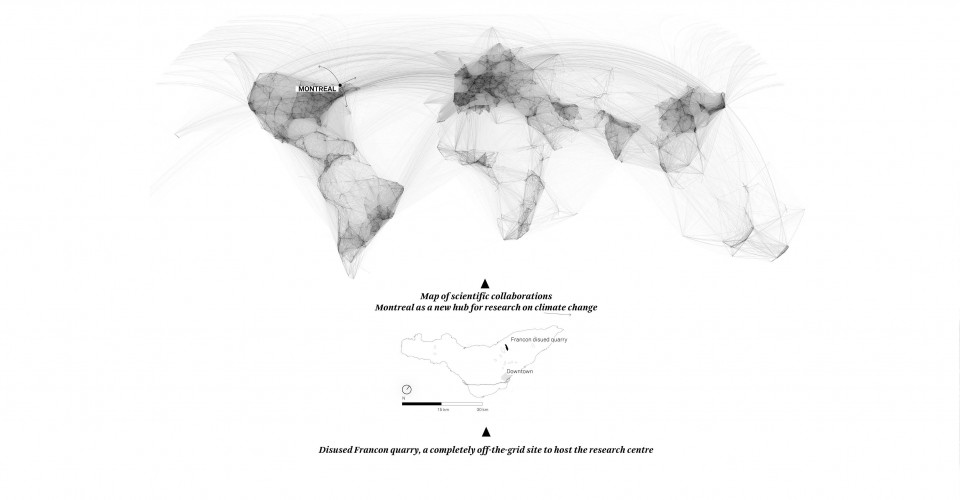
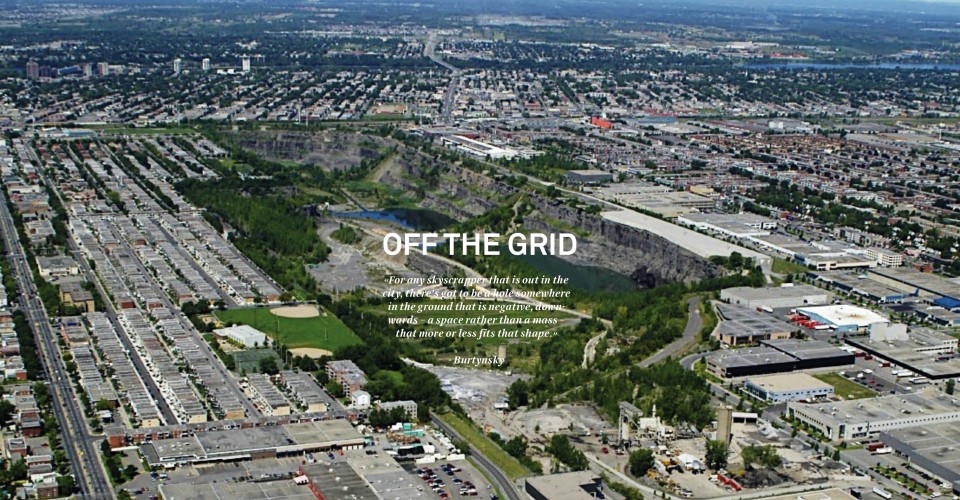
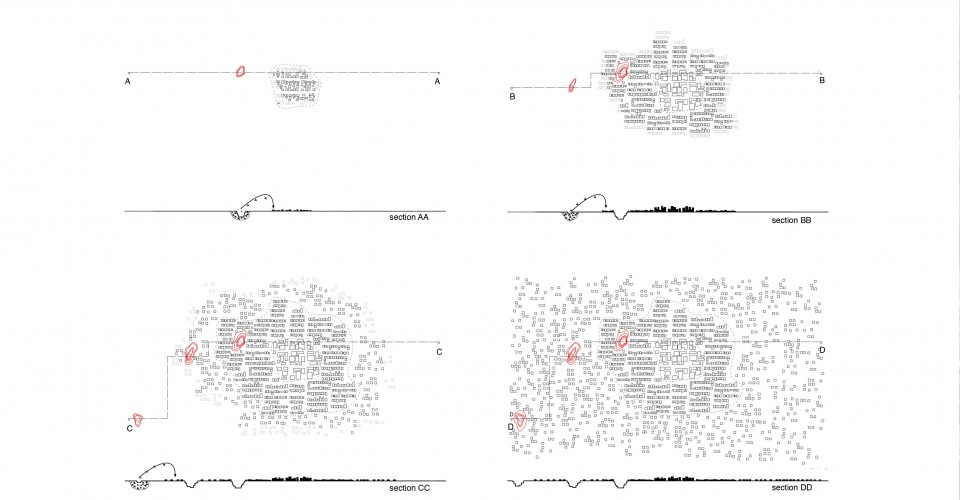
The Francon quarry, situated in the Saint-Michel borough in Montreal, is an ideal space for experimentation due in part to the mechanisms that led to its genesis, its insularity, its particularity to behave as the inverse of the city and its off-the-grid character. Indeed, the urban quarries are built in parallel with the city’s expansion, yet they act autonomously.
(003) CONCEPT
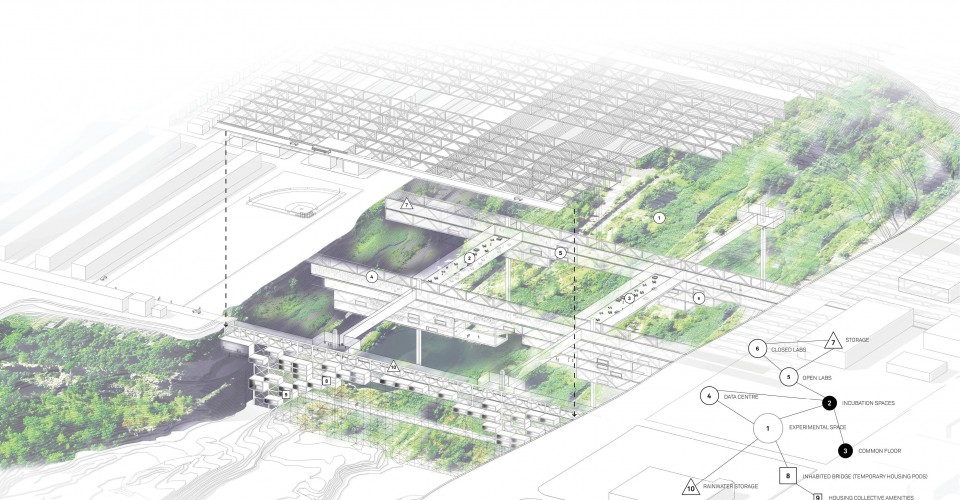
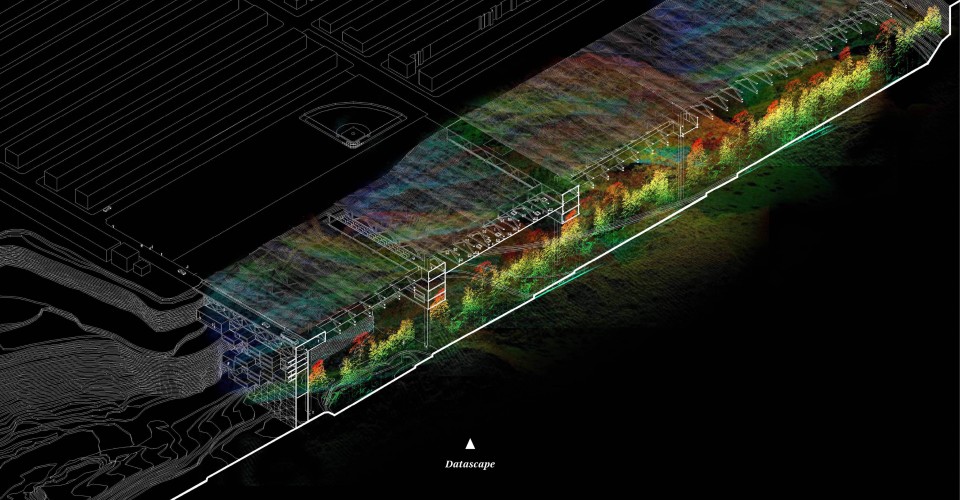
The proposal is a research centre on climate change. A part of the quarry is encapsulated delineating an experimental space where the scientists can test the effects of climatic projections for 2050, 2100 and more.
(004) STRUCTURE
The need to free the grounds for experimentation demands a structure spanning the quarry that is inspired by deck truss bridges. The height of the structure is proportional to its span – it reaches a point where the structure is high enough to inhabit. The space created by the structure forms a spine: the programmatic elements are inserted in it or are hanging from it. In addition, it creates a surface that connects the two banks of the quarry, enabling a variety of urban connections (the inhabited bridge, the green spine and the pedestrian links).
PROGRAM
The proposal includes a climate change research center (open and closed laboratories, data center, incubation spaces to foster innovation and trans-disciplinary exchanges, common spaces, rainwater storage), the inhabited bridge (temporary housing for scientists and students, collective equipment) and the experimental ground lab.
MATERIALITY
Ethylene tetrafluoroethylene (ETFE) cushions form the envelope. Because of the perceptual qualities of the ETFE’s cushions, crossing the quarry becomes experiential trail.